24 July, 2026
James Franklin introduces his book The Necessities Underlying Reality, edited by James Franklin and Jeremiah Joven Joaquin (Bloomsbury, 2026) and available open-access.
Sometimes, a book comes along that captures the spirit of the age. It gives voice to the received ideas of the time and expresses them in digestible form, with a superficial novelty of packaging. It has the wind of the Zeitgeist in its sails and goes on to glory. This is not that book.
This book is in the spirit of a century. Unfortunately, the century it’s in the spirit of is not the 21st, or even the 20th. Perhaps the 14th (and if you can’t recall much about the intellectual highlights of the 14th century, that just goes to show; think Duns Scotus’s Oxford). Or possibly the 4th century BC, when Aristotle attuned to necessities and Euclid wrote the Elements as a course on the necessities of geometry.
But not now. We’ve lost contact with the world of necessities and we have to start from scratch.
Here’s what the book is about: we know many contingent facts, of history and biography, geography and local laws and customs. “Contingent” means: they could have been otherwise. And that’s their attraction: the point of biographies is that everyone’s life story is different, and we travel to foreign parts to see something new and not like here. But there are also some truths that are the same the world over, such as scientific laws. If you are an Australian physicist, you’re qualified to work in French physics, in a way you aren’t if you’re an Australian lawyer or Australian historian. French law and history are different, French physics isn’t.
But though the laws of physics are true all over the world, they are not necessarily true, true in all possible worlds. That was the point of the early Royal Society calling the regularities of nature “laws”, to suggest they were laid down by God and he could have made them different and could make exceptions to them.
Beyond those, however, or deeper than those, is a more basic level of reality where the laws are absolutely necessary: “the necessities underlying reality”, in the book’s title. They are true in all possible worlds, and if you are expert in them, as mathematicians among others are, you are assured employment anywhere in this world, or in any other. The book describes four kinds of such absolute necessities: mathematical ones, ethical ones, logical ones, and ones concerned with the relation of evidence to conclusion.
Let me demonstrate a simple one of the necessities I am talking about.
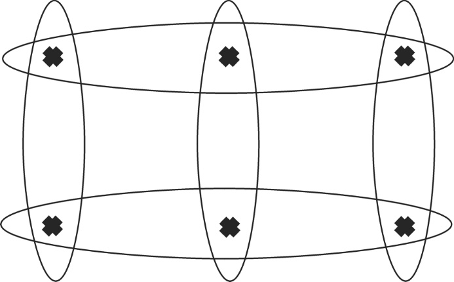
Here are 6 stars. They’re arranged in two rows of 3, i.e. 2 x 3. You can also see them as three columns of 2, i.e. 3 x 2. They’re the same stars, therefore 2 x 3 = 3 x 2. 2 x 3 must be 3 x 2; it’s a necessity; it can’t be otherwise, not by changing the laws of nature, not by miracle. It is not a triviality: 2 x 3 does not mean the same as 3 x 2: on the contrary, one means taking 2 lots of 3 and the other means taking 3 lots of 2. But the results must be the same. It is not about a world of formulas or disconnected from the physical world we live in either – it applies to the real physical stars on paper, or any other six beings whatsoever, whether physical, mental, electronic, astral or anything else.
Furthermore, once you’ve grasped that, with your faculty of understanding or intuition, you can see that it doesn’t matter if the numbers are 2 and 3. What if there were 4 across and 5 down? Are you sure that 4 x 5 = 5 x 4? Sure, for the same reason. 2 million x 3 million = 3 million x 2 million? Absolutely. Your understanding has given you access to an infinite number of necessary truths.
There are plenty more mathematical necessities where that came from. The celebrated Königsberg bridges example is another, where Euler proved that it was impossible to walk over all seven bridges once and once only.
So now you can see the metaphor of “underlying” in the book’s title. It’s like this: you have a building site. You could leave it empty, but if you do build, there are some constraints. The foundations, columns and girders have to be a certain way. They underlie what you can make choices about later. Then you can clothe them in cladding and windows, with a certain amount of flexibility but not too much. Then you’re free to fit out the inside with human choices of décor, artworks, water coolers and signage. Similarly if you’re creating a world: you have to start with the absolute necessities, which you can’t choose; then you can choose the laws of nature around them; then the contingent facts of history, the decorative detail, wrap around them.
I will deal more briefly with some of the other main controversial themes of the book. One is the objectivity of ethics, which is as strong as the objectivity of mathematics. It is easy to think of ethics as a set of customs evolved to ensure cooperation in tribes so we can all get on with our business – in Annette Baier’s words, “traffic rules for self-assertors”. That sort of naturalistic, transactional view of ethics corrupts the youth. Anyone can see it doesn’t give a good reason why you should act ethically, if you can get away with acting unethically. When you face a tough ethical choice, where it’s going to cost something to do the right thing, if you believe in that weak view of ethics you’ll take the easy course. You can see the results in the newspapers every day, and that’s just the ones who get caught.
So what is the right view of ethics? First, it is fundamentally not about actions or what to do at all. It is about what kinds of things have moral worth – what kinds of things matter when something happens to them. People, for instance. As I wrote in the book:
What happens to humans can be a tragedy. What happens to rocks cannot. When we see pictures of atrocities, we understand that the victims were people like us, people who until their end possessed reason, apprehensions, personal unity, hopes, loves, suffering and individuality as we do. That is what makes their death a tragedy and not, like the explosion of a lifeless galaxy, a firework. Gross metaphysical differences like that between humans and rocks imply gross moral differences.
That “imply” is an absolute necessity, as strong as those of mathematics.
Another theme is the necessary connection between evidence and conclusion. Given a body of evidence, such as in scientific experiments or in a court of law, and a possible conclusion, such as the guilt of the accused, does the evidence make the conclusion highly probable? That is a matter of absolute necessity, and there is a right and a wrong answer in any case. The jury who convicted Cardinal Pell got the wrong answer, and the High Court of Australia had to tell them that the relation between the evidence and the conclusion was otherwise.
A last theme is about the problem of evil. As everyone knows, one of the main reasons for not believing in God is that surely a good and omnipotent God would not create a world with the terrible evils we see in it – a very fair question. But someone with a good understanding of absolute necessities may grasp that, so to speak, omnipotence is not all it’s cracked up to be. Absolute necessities constrain even God, and in a complex world like ours there are very many of them. If you are omniscient, you see how hard it is to manage the tradeoffs. Creating a perfect world is something like trying to cross all the Königsberg bridges just once.
What is there in this rarefied air of absolute necessities for those who are not professional philosophers and live in the so-called “real” world? I have two answers. The first is the reply Euclid is said to have given to the student who asked what he would get out of studying geometry – “Give him a three-obol coin, since he has to make gain out of what he learns.” The point is to have a break from making gain and giving practical opinions and frenetically organising, and just contemplate, as you do when you enter an art gallery.
Having said that, and since you insist, I have a second answer. There are a few practical and political consequences, mainly about the attitude you take to matters of controversy. If you have a solid grasp of necessities, you will be confident in doing what’s right and won’t think all values are equally worthy of respect and anything goes. In ethics and in evidence evaluation, as in mathematics, there are easy questions and hard ones, but there is a right answer each time. You won’t be intimidated by political correctness or any other fads in ideas – you’ll go and evaluate the evidence yourself, according to rational principles. You won’t be intimidated from looking into questions you don’t yet know about either: logic and evidence work the same in all subjects, you just have to put in the work.
Now get out there, think straight, and behave virtuously.
James Franklin is Honorary Professor in the School of Mathematics and Statistics at the University of New South Wales, Sydney. His other books in philosophy and the history of ideas include The Science of Conjecture: Evidence and Probability before Pascal (2001), Corrupting the Youth: A History of Philosophy in Australia (2003) and An Aristotelian Realist Philosophy of Mathematics (2014).