June 15, 2026
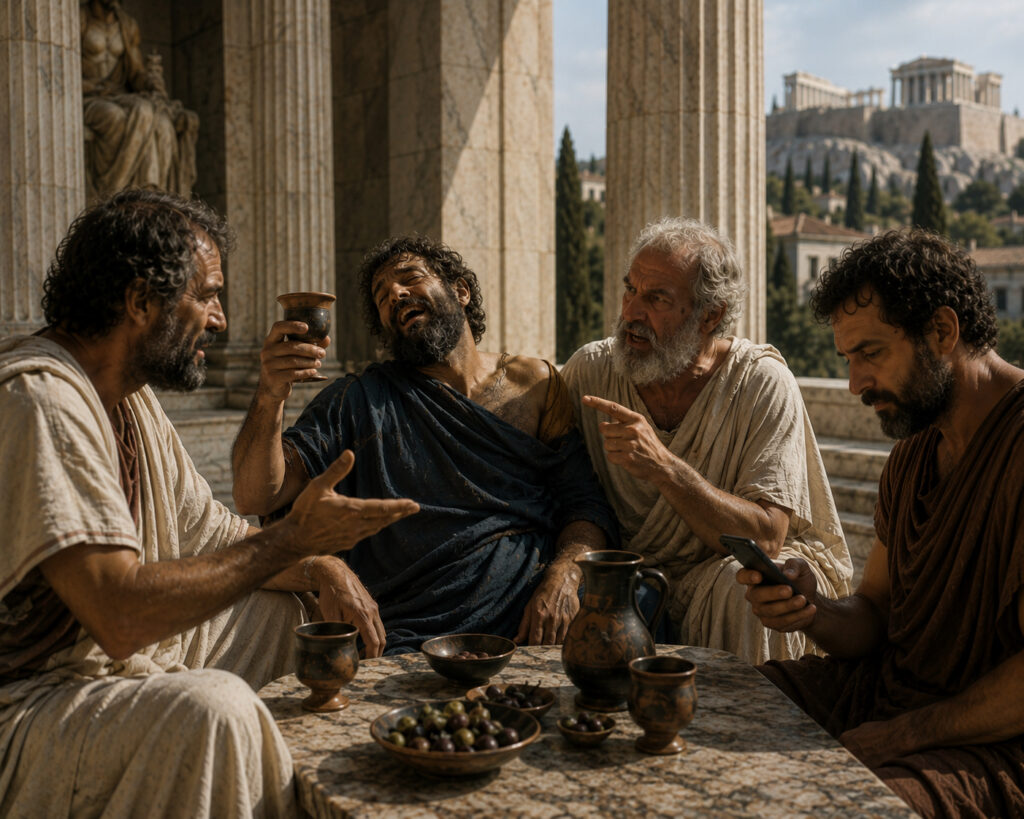
Following Socrates’ funeral ceremony, two attendees gather around the trays of food and refreshments in the reception hall.
Crito: I can tell how upset you are at the passing of our teacher, dear Phaedo. But remember, death is either a dreamless sleep or a transportation of the soul. And in neither case, is it anything to fear.
Phaedo: I’m not so sure. Not because the dreamless sleep sounds bad—I was enjoying one through the eulogies. I’m worried about the other possibility.
C: But in that case, he will have escaped those who call themselves judges here and sits now before the True Judges.
P: That’s what worries me.
C: You fear our teacher will be judged unfavorably?
P: Not exactly. I think when he said that stuff about the True Judges on the other side, he wasn’t aware of the new procedures that have been put in place.
C: New procedures?
P: Yeah, the new policy is that the True Judges will hear your case and judge you only if your death has been formally acknowledged by the Dead Philosopher Memorial Notice Bureau. And before that happens, someone on this side must submit a Dead Philosopher Acknowledgement Request. I filled in the form and uploaded his CV through the Bureau’s new OneDeath Portal. But there are so many dead philosophers nowadays and so many requests to have their deaths acknowledged, there just isn’t time to cover them all.
C: How then does the Bureau decide which dead philosophers to acknowledge?
P: In the only way possible. By ranking them.
C: Ranking them?
P: Yeah, only those philosophers who have achieved a sufficiently high level of notoriety in the field will have their deaths formally acknowledged. And only then does the case go to the True Judges.
C: And you fear the Bureau will not rank our teacher highly enough to acknowledge his death? And then he will not appear before the True Judges?
P: Exactly. The way it works now, all the low ranked philosophers go unacknowledged in an unjudgeable limbo for all eternity or their deaths are only recognized by one of the lesser, unauthorized dead philosopher memorial notice boards.
C: There are indeed those who would regard that as a fate worse than not having one’s death acknowledged at all or, for that matter, even worse than death itself. Perhaps it is better for a philosopher to have never philosophized than to have done so and been lowly ranked. But why would such a miserable fate befall our teacher? He was the wisest and the best and the justest—especially the justest. All other philosophers know his name and his important moral teachings. Many consult those teachings daily. There is no philosopher with the same level of impact on philosophy.
P: Except maybe he who ranks the dead. Seriously though, Socrates never published anything.
C: I believe you are overlooking our teacher’s influential blog.
P: The Bureau wants to see peer-reviewed academic work in top-tier venues. The kind of stuff that contributes to the knowledge base and merits an international reputation of impeccable—Hey take it easy, Thrasymachus! How ‘bout saving some saganaki for the rest of us?
Thrasymachus: Don’t worry, I’m leaving the taramasalata for you guys. Stuff smells worse than that dirty old man’s corpse. Anyway, what kind of bullshit are you two dorks going on about over here?
C: Phaedo was just informing me of the new policies governing the formal acknowledgement of dead philosophers.
T: Oh, I know all about that. I heard they’re doing the same thing for departments now.
C: For departments?
P: I’ve heard that too. Used to be, whenever a philosophy department got eliminated, this was a newsworthy event. But now, so many departments are getting the labrys, it’s just not possible to acknowledge each one. So, if you want your dead department memorialized, you must submit a request. And only those departments that are ranked highly enough will have their deaths formally acknowledged. The rest pass as they lived—unacknowledged and unknown. I can see why this is necessary but it’s also very sad.
T: Not sad at all. Loser philosophy departments suck away time and money and deserve to be eliminated, just like the loser philosophers who work there. Have you seen these places? It’s like if we let people who could never cut it in the Olympics hang around and lob discus in the local leagues into their 80s. Pathetic and embarrassing. Why bother acknowledging the death of some place or person nobody ever heard of? Nobody who matters anyway. It’s a waste of papyrus.
C: We must remember that these are people you are talking about Thrasymachus. I cannot agree with you.
T: What better proof I’m right? And yeah, people are people. But some people really are losers.
C: At the same time, I fear the elitist attitudes you evince are widely shared but never so honestly expressed. Thus, your candor is appreciated. In any event, Phaedo fears our teacher’s record of peer-reviewed research will not suffice to warrant an official death acknowledgement.
T: I can see why he’s worried. I got a pet ant that’s published more than your guy just by walking around in the sand. Draws a mean Themistocles too.
C: It occurs to me now, however, that Phaedo overlooks the fact that our teacher is and has always been a tireless defender and promoter of the ideals of academic freedom and freedom of speech. And this is the foundation of all inquiry, especially in philosophy. Herein lies a large part of the value of his influential blog.
P: I’ve been thinking about that too. And yeah, he said he believed in that stuff but I’m not so sure. Just look at how his blog covered the Aristophanes case.
T: The what?
C: I believe Phaedo is referring to the controversy surrounding Aristophanes’ claim that there are only three sexes: male, female, and androgynous. Aristophanes also claims there are clear boundaries that distinguish the three sexes and, since it is determined at creation, sex is immutable.
T: Oh, I remember now. People are still mad about that? What is this, 2020 BC?
C: There are those who say little has changed in philosophy since those turbulent times.
P: Can’t blame them. Instead of engaging with his arguments, lots of people just dismiss Aristophanes’ view with vicious ad hominem attacks.
T: What a bunch of assholes.
C: But to return to your earlier point, dear Phaedo, why are you so concerned about our teacher’s coverage of Aristophanes on his blog? He has explicitly said—and said repeatedly—that Aristophanes has the right to defend the historical-trinary view of sex, even if others find it offensive.
P: Anybody can say that sort of thing. Remember when Aristophanes was honored by the Playwright’s Guild and a bunch of philosophers objected in the Journal of Open Letters and Petitions?
T: The hottest periodical in the business! Now I don’t like to punch down and go after my inferiors. That’s why I only sign cancellation petitions against myself.
P: Keeps you pretty busy, I imagine. Anyway, the JOLP letter goes on about academic freedom and how important it is but then, in the same breath, we’re told this important freedom mustn’t be used to “harm” people.
C: And what do you find objectionable in that? Do you think it permissible to commit harm?
P: If you’re going around accusing others of committing harm, you should show us the people who’ve been harmed.
C: I seem to recall our teacher making a similar point at the trial.
P: Now, you can expand the definition of harm to where people are harmed by someone simply defending a controversial opinion. But if you think it’s that easy to harm somebody and you think academic freedom doesn’t cover words that harm, then you don’t really believe in it.
C: Perhaps. However, the letter you speak of was not primarily in reaction to Aristophanes’ words but his deeds. Aristophanes was working to get his trinary view of sex built into Athenian law and the regulations governing our javelin competitions.
P: Okay, but if you think there’s something wrong with that, you have to engage with Aristophanes’ arguments—something nobody does in these letters.
Euthyphro: And no one should! Ever. Engaging with the arguments of Aristophanes and his ilk—even if you are attacking them—only serves to amplify their disgusting signal.
C: Oh greetings, dear Euthyphro. I am pleased to see you have come to join us in honoring Socrates. This is very noble of you, as it is widely known that the two of you have had your differences.
E: I’m not here to honor anybody, especially that clown. I was just leaving my dad’s execution and felt a little hungry. So I thought I’d duck in here and see what you guys had for food. Looks like I missed the saganaki. But I’m glad to see there’s still plenty of taramasalata left.
C: To return to our discussion, Phaedo, the piece in JOLP did not contend, as others have, that Aristophanes should be stripped of his position in the Guild. The concerned philosophers only objected to him receiving honors as they felt this was both undeserved and politically motivated. Do they not have the right to express that opinion?
P: Sure they do. But, given what else they say, I don’t see why they didn’t call for him to be thrown out of the Guild. They contend that academic freedom does not protect those who harm and, whether it’s through his words or his actions, that’s what they accuse Aristophanes of doing. So, from their point of view, why shouldn’t he be fired and tossed into the barathron just like Euthyphro’s father?
C: Surely, you are familiar with the idea that there are degrees of harm.
P: But if they think these alleged harms are minor and don’t warrant a firing, why make such a spectacle of things with a moralistic and condemnatory open letter? I think they want Aristophanes to be punished for his philosophical views, but they know that coming out and saying so won’t play well with people who don’t hate philosophy. So, instead of just saying what they really think and defending it, they prefer to step on somebody else so they can promote their own image and good guy status. All this moral grandstanding is ruining philosophy.
C: I believe you are the one grandstanding, dear Phaedo. To accuse other philosophers of aiming at self-promotion rather than truth is to signal your own virtue—love of truth being the primary virtue of the philosopher. Thus, your very accusation is aimed not at truth but at self-promotion. Furthermore, you have no reason to think others are grandstanding, because no one can ever know anyone else’s intentions.
T: No one but you, apparently.
C: In any case, Phaedo, I fail to see what this has to do with our teacher. He was not a signatory of the JOLP letter and, as I said before, he consistently defended Aristophanes’ right to academic freedom, all the while taking no position on the truth or falsity of the trinary view of sex.
P: I’m not so sure his defense is consistent. When Aristophanes’ case comes up on his blog, he says the same kind of thing the others said in their letter. Yes, academic freedom is important but then, we’re also told, it’s often in tension with other values that must be promoted and protected and we must achieve a balance.
T: There’s the bit where you say it and the bit where you take it back.
P: And, although he says he never read Aristophanes’ work—a nice excuse for not having to defend an opinion on it, I guess—he did call Aristophanes’ behavior “appalling”.
E: Socrates is disgusting. Regardless of his own views on the matter, his blog is a constant showcase for bigotry. Running these stories on Aristophanes encourages other ignorant people to believe there’s a legitimate academic controversy over the historical-trinary view of sex. As for Aristophanes himself, only someone who is severely inexpert, incompetent, and in the grip of a hidden agenda of hate would epistemically trespass into the discussion to advocate for such a grotesque and discredited position. If everyone would simply consult the literature on the topic, they’d find that all the scholars with genuine, certified expertise hate the trinary view.
T: Do they hate it because they’re certified or are they certified because they hate it?
E: I don’t know what you mean, Thrasymachus. But I also object to Aristophanes being called appalling because that’s a severe understatement. Haven’t you seen the metadata?
P: What’s metadata?
E: “What is metadata?” The question awakens expectations of a discussion about metadata. This we will forgo. Instead, we will take up a particular metadata question. In this way it seems we will let ourselves be transposed directly into the metadata. Only in this way will we provide the metadata the proper occasion to introduce itself.
T: Sounds like the taramasalata is starting to take hold.
C: I believe Euthyphro is referring to a controversial document that was submitted to the Thirty Tyrants concerning some newly proposed legislation.
E: Indeed. Our crack team of skilled metadatalogical researchers recently revealed that Aristophanes was instrumental in the production of that obscene document, thus proving that he is a paid shadow agent working in service of The Thirty and their ruthless campaign of cruelty and dehumanization.
T: Do you know if they’re still hiring?
P: Look, the problem here is that if you claim to support freedom of speech in academic contexts—
E: I don’t! Abstract pseudo-philosophical discussions of freedom of speech and academic freedom obscure what is really at issue in these ill-conceived “debates”, namely, the lives of the oppressed and murdered. Philosophers can’t just sit around casually debating whether people have the right to exist as if they’re discussing some trivial metaphysical matter like the existence of tables.
T: Sure they can. It’s the same issue.
E: What?
T: If α is a table, then α is composed of finitely many atoms. And if you have a table and remove a single atom from it, then you still have a table. In other words, nothing can go from being a table to not being one by the removal of a single atom. From this, it follows that if you remove all of the atoms from α one by one, you still have a table. And that is absurd. Therefore, tables do not exist. Now, once you understand that, you’ll see that the very same argument applies just as well to people. Nothing goes from being a person to not being one by removal of a single atom and so, if you remove all the atoms one by one, you still have a person which is absurd. So, people do not exist. And if there are no people, then there are no people who are tra—
P: As interesting as all that is Thrasymachus, I think we’re getting off-topic.
E: No we’re not. He’s convinced me. Anyone who debates the existence of tables, or permits others to do so, is complicit in murder.
P: My point is that you can’t consistently claim to be a noble defender of academic freedom and then go around condemning people for advancing controversial views—whether their audience is other philosophers or government officials.
C: I must say, dear Phaedo, this is a very confused and clichéd non-sequitur. Criticism of Aristophones’ partnership with an evil and tyrannical governmental administration is not an infringement upon his freedom. And your disingenuous suggestion that it is only serves to provide cover for people in powerful positions to continue to their efforts to undermine that very freedom. In that sense, moral criticism of Aristophanes is the noblest and justest expression of the ideal. Do you not agree that freedom of speech protects the right of people like Socrates to object to the behavior of others?
P: Of course. It even permits people to have a massive public meltdown and contend that anyone who debates the existence of tables is a murderer.
E: I’d respond to that, Phaedo, but that would only encourage further “debate”. And that will only solicit another round of petty insults from you and your disgusting tribe of vile fucking humans. This is why I refuse to participate. Anyone who advocates for the most vulnerable and tries to protect them from harm is deemed a hypersensitive snowflake, while those who defend the status quo get to wrap themselves in the flag of academic freedom. I will not be a party to that. This entire discourse around academic freedom and freedom of speech only draws attention away from the real harm done to real people, especially our most vulnerable and marginalized groups—the very people whose interests philosophy always ignores.
T: Yeah, we never hear much about them at all.
E: To participate or even permit this kind of conversation—especially in serious academic contexts—exhibits a callous disregard for real human suffering. We must not tolerate those whose words endanger the lives of others and who treat people like inanimate pieces in a stupid and trivial little intellectual game. The time for discussion is over.
T: You sure say a lot for someone who refuses to participate in the conversation.
C: I still think you are missing the point, dear Phaedo. If academic freedom protects the right of one philosopher to call the behavior of another immoral, as you admit, what is objectionable in our teacher’s condemnation of Aristophanes? And why should this make us skeptical of his stated commitment to academic freedom?
P: Because if you really believe in the ideals of open inquiry, you don’t go around shaming and ostracizing people for expressing their views—even though you have the right to do that. This is especially so when the people you are shaming offer argument and evidence in defense of their views and you offer no objection, other than moral condemnation. That’s the funny thing about academic freedom and freedom of speech more generally. If you really believe in these ideals and take them to be fundamental, you must not only permit but encourage others to argue against them. And you must engage with those arguments and be willing to change your mind if that is what the best argument dictates. Anything else is hypocritical and logically contradictory. On the other hand, those who reject these ideals are not only free but required to do what they can to prevent dissent from whatever truths they hold most dear. And, should someone dissent anyway, they can and must refuse to engage and do what they can to shut them up. In that way, the enemies of academic freedom will always have a rhetorical, political, and epistemic advantage over their opponents.
T: Saves time too. Now what do you make of all that Euthyphro?
E: I wasn’t listening. And my stomach hurts. Did one of you poison the food?
C: If what you suggest is true, dear Phaedo—and I am certainly not conceding that it is—then our teacher is a formidable enemy of academic freedom and freedom of speech more generally. But, if those who truly believe in these ideals want others to attack them, why then would they not herald Socrates as a hero?
T: Any political party needs its enemies more than it needs friends. Only in opposition does freedom become necessary.
P: Sure, so long as the enemies are out there playing by the same rules—making arguments, responding to objections, that sort of thing. But that’s not what’s happening here. Socrates constantly controlled and curated the content of his blog behind the scenes to advance his own worldview. It’s dirty spheristics. Did you hear how Aristophanes’ critical review of Diotima’s book was censored by the Guild? If you did, it wasn’t from Socrates. Although his blog covered this topic regularly, he did not even mention this story because it makes the side he favors look bad.
C: Rejection of a book review is not censorship but a completely normal part of the academic publication process that is hardly newsworthy. And there are many other reasons why such a story would not be covered on our teacher’s blog. Perhaps he refrained because he could not obtain all the facts. That’s just good journalism. Also, it is unclear whether Aristophanes’ critical review was legal under Athenian hate speech law. And we mustn’t forget that Aristophanes had a blog of his own where he permitted others to make comments that may have also been illegal. So, this is a very complex issue and thus it is wise to take care not to present a biased and one-sided account of things—sometimes that will mean not running certain inflammatory stories. The fact that Socrates declines to run such a story only demonstrates his deep commitment to truth and objectivity. Furthermore, our teacher is free to prioritize the issues in accordance with his own judgment of what is most important and true. It is his personal blog after all.
P: It’s that when it’s convenient. Otherwise, we’re supposed to think it’s the world’s only objective and in-depth source of news about philosophy. And the problem I’m talking about here is far bigger than Socrates. He is merely a reflection of a certain anti-philosophical sickness that’s polluted the academy for decades. The fact that so many philosophers have for so long refused to take a consistently strong stand for academic freedom and for philosophy itself is what makes them such easy targets for tyrants. They cannot convincingly defend philosophy against politically motivated attacks that come from the people they don’t like, because they never defended it against politically motivated attacks from the people they do. If anything, they were the ones doing the attacking. And speaking of comments, did you ever notice Socrates’ selective policing of them? Insults that favor views he likes are fine but try it from the other side and you get scolded and kicked off the thread.
C: Phaedo, it is time for you to take a break. This is not a good look. You need to step away and go touch grass.
P: What?
T: I think he’s inviting you to bend over. I also think you’re both missing the subtle genius of your own teacher. You see, nobody really believes in academic freedom or freedom of speech. But we’re at a point in history where everyone is expected to say they do. So that’s what you do. And in the easy cases that everybody agrees on, you can be full-throated and sincere. In the more controversial cases—like Aristophanes—you say you do but you add little caveats about harms and tensions and so forth. That way, people on your side get the message. Then, when somebody comes in from the other side and complains that you aren’t toeing the line, you point back to that time you stuck up for Aristophanes but without mentioning your caveats and moral condemnations. And then there’s all those things you do in the background to favor your own point of view—selective tone policing, emphasizing some stories but not others, or some parts of a story and not others, writing headlines that favor your own take on the story, all that kind of thing. You can even let people complain about that because you know they can’t prove anything and you can just deny that’s what you’ve been up to. It’s brilliant. That’s why Socrates was the best and wisest and the justest philosopher ever to philosophize—especially the justest. It’s a shame you guys are too stupid to appreciate this.
C: This is an infantile and superficial analysis, Thrasymachus. And it is typical of the level of discussion philosophers fall into whenever these issues arise. It saddens me that philosophers cannot discuss important and complex matters respectfully, without falling into arrogant condescension and snide personal attacks based on cynical and unverifiable false claims. I would address the mistakes in your reasoning but I do not have time to moderate everything everyone wants to say here. Life is short. Comments are now closed.
P: What are you talking about? You can’t close comm—by the dog, what is that smell?!
T: Dog’s got nothing to do with it. That is definitely human. The taramasalata appears to have found the fast lane down river.
P: Now that’s what I call a massive public meltdown.
E: This is a completely natural bodily process and I will not be shamed for it. Explosive diarrhea should be cherished and celebrated.
T: I agree. That’s why I bought a paid subscription to Hypatia’s newsletter.
E: Does anyone have a strigil?
T: You know, I’ve always wondered how the True Judges ensure objectivity when they hear a case.
P: I heard they operate under a magical veil of ignorance.
T: A what now?
P: Veil of ignorance. It’s like this spell they cast over themselves where they forget any details of the case that might introduce bias. I heard the True Judges don’t even know they’re serving as judges before they vote.
T: What happens if it’s a tie?
Michael Veber is Professor of Philosophy at East Carolina University. He is the author of Epistemology: What It Is and Why You Should Care and Tell Me Something I Don’t Know: Dialogues in Epistemology.