30 March, 2026
What do gender ideology, Covid lockdowns, cancel culture, DEI, encroachments on academic freedom, NIMBYist planning restrictions, police and prison abolitionism, net zero climate policies, and the obsolescence of the male artist all have in common? It is tempting to say: nothing. In a loose sense, they are all frontiers in the ongoing culture war; perhaps they are all things that anyone of sound political and aesthetic instincts should be against. But beyond that, no deeper unity is obvious. We argue that this impression is mistaken. These phenomena are best understood as manifestations of a single underlying pathology.
Cultural sicknesses are somewhat like physical ones, and – having passed through phases of institutional denial, anger, and bargaining – many commentators have now embarked on the post-mortem phase of the culture war, offering various diagnoses as to what went wrong, especially with progressive ideology, whose mistakes have often been the more outlandish. According to some, the problem was that the left became possessed by a quasi-religious fervor: gripped by a ‘new puritanism’. As others see the problem, progressives were victims of a ‘mind virus’ that disabled their cognition in some systematic way. They became ‘intellectually captured’. Another, less dramatic, refrain is that proponents of woke ideology lost the capacity for ‘nuance’.
Though superficially plausible, none of these diagnoses feels altogether satisfying, and the last – that culture has become insufficiently nuanced – risks getting things exactly wrong. The problem with many self-identified progressives has not been a lack of nuance, but a surfeit of it. Many of the chief antagonists in the ongoing culture war are sensitive to too many considerations, and, fondly imagining themselves able to do justice to all, do justice to none.
We have a different diagnosis of what has gone wrong in political culture. Despite our title, it may not be the problem with everything, but it is a problem with everything, in the sense that no part of human life is unaffected by it. Sometimes the distortions in which it results are negligible; sometimes they are as catastrophic as can be. The problem we are interested in is one that intelligent people are inchoately sensitive to, and which they will recognize when its structure is made vivid to them. Almost everyone will be familiar with, and frequently frustrated by, its characteristic symptoms. Yet to our knowledge, the problem has never been named or described in its full generality. We give it a name. We call it ‘exceptionalism’.
This essay provides three ways to understand exceptionalism. The first is as the fatal flaw of a specific kind of person, who flatters himself on his own want of restraint and principle. The second is as a pathology similar to the widely recognized scientific pathology of overfitting, whereby good theories are rejected to accommodate bad data. And the third, as we have already indicated, is as the unifying feature of a wide variety of cultural and political idiocies. Above all, our aim is to help orient the reader towards the problem of exceptionalism: to put them on the lookout for it, so that they can recognize it when they see it – and thereby enjoy, if nothing else, the pleasure of knowing what is wrong with the world these days.
Exceptionalism and the exceptionalist
At its heart, exceptionalism is an intellectual problem: it is a pathology of mind. But an easier way to understand what is wrong with exceptionalism is to understand what is wrong with the person who exemplifies it: the exceptionalist. Just as exceptionalism is something that everyone has encountered, the exceptionalist is someone that everyone has met. He thinks that there are people or things to whom the usual rules don’t apply. In fact, in a reflective mode the exceptionalist often denies that the usual rules are rules, precisely because they don’t make exceptions for the exceptionalist’s special categories.
In a slogan, the exceptionalist’s characteristic vice is that he is abnormally disposed to make exceptions. His habit is to read too much into anomalies and aberrations, flukes and coincidences, misapprehensions and misperceptions. Isolated incidents, strange happenings, or even just paranoid imaginings, inspire him to carve ugly qualifications into elegant principles and well-supported generalizations.
One familiar kind of exceptionalist puts this unprincipled instinct at the service of just one or two privileged categories. A second kind allows his instinct to range more indiscriminately. Specialized conspiracy theorists, fanatics and religious believers are often of the first kind. Think, for instance, of the credit that religions have historically given to reports of miracles – that is, to reports which are only true if various well-supported generalizations about the world are not; or the way the conspiracy-minded nutjob will dismiss vast swathes of evidence that tell against his thesis, while attaching enormous significance to small and inconclusive details that seem to support his suspicions.
The second kind of exceptionalism is better exemplified by woke activists, newspaper journalists, the chronically online. Such exceptionalists automatically diagnose whatever subject happens to be salient as a likely exception to some general norm or regularity. This instinct seems to be of particular professional help in journalism and media, where it serves to sustain the customary cycle of hysteria, outrage and generalized over-reaction to each day’s twist of the news cycle. (“This time politics really is broken for good!”, “Doesn’t this recent TV show/film/book proves culture has gone into an unstoppable tailspin of decline?”, “Why my recent trip to the supermarket reveals the global economy is headed for disaster” – your daily newspaper and social media feed are full of hack theorists willing to balance the most sweeping conjectures on the tip of whichever carefully cherry-picked datapoint is closest to hand.)
Journalists may be indiscriminate exceptionalists by trade and temperament, but the differences between ‘single-minded’ and ‘indiscriminate’ exceptionalists should not be overstated. More unites than divides them. The indiscriminate exceptionalist differs from the single-minded exceptionalist only in that he is even quicker to pull the trigger when it comes to dropping well-supported generalizations from his belief system. Tell him that you heard about a tribe in the Amazon whose language lacks a feature that every other recorded natural language has possessed, and his response will be: ‘Cool! Language is so interesting.’ Tell him that you watched a TV show in which a normal 13-year-old boy committed murder, and his response will be: ‘Wow, teenage boys these days are in more trouble than ever, aren’t they?’
In some ways, the single-minded exceptionalist is an easier target to engage with than the indiscriminate exceptionalist; it can be easier to see where he is coming from. But in other respects, the indiscriminate exceptionalist provides a better model of exceptionalism. In particular, he may provide a better model of how exceptionalism plays out in the long run at a cultural level. He is, after all, a bit like what you would get if you put a bunch of single-minded exceptionalists in a room and allowed them an equal say.
Temperamentally, the exceptionalist is prone to panic. He swiftly abandons his long-standing beliefs and intentions in the face of salient threats. Sometimes that cognitive over-reaction can translate into something more conventionally hysterical. In February last year, there were three widely publicized air crashes, in Alaska, Toronto and Washington DC, all within a few weeks of each other. An exceptionalist, perhaps one predisposed to being unnerved by air travel, might respond by cancelling his upcoming trip – clearly something is up with the world’s planes! Under pressure from a few vivid but ultimately statistically insignificant cases, he has succumbed to the panicked urge to reject a simple and overwhelmingly well-supported generalization – in this case, that flying is safe. That is a typical instance of exceptionalist reasoning. Though perhaps merely comical in an individual neurotic, doubling down on exceptionalist instincts can quickly have anti-social effects. The exceptionalist thrills in subjecting himself and others to artificial cramps and restrictions, as a safeguard against the barest possibility of harm.
So far, our way of characterizing the exceptionalist combines elements of the intuitive and counter-intuitive. Few would happily admit to a tendency to be blown off course when frightened. ‘Don’t panic’ is a platitude; and as with so many platitudes, to hear it is to flatter oneself on complying with it. On the other hand, aren’t complications, compromises and qualifications good things – marks of maturity? The world, not least the human world, is messy and complex. Isn’t it only right to take as much as possible of its messiness and complexity into account? Surely, we should make all the exceptions that are necessary– and no fewer. Each proposed individual exception must be judged on its individual merits, with no background anti-exceptionalist agenda.
Exceptionalists are fond of that line of thought. It enables them to launder their exceptionalism as mere judiciousness. But the demand to judge every proposed individual exception on its merits is hopelessly misguided. The poor soul who really took nothing for granted would, after all, be the dupe of every snake-oil salesman in a 100-mile radius (“maybe this time it will work…”). More subtly, the implied exceptionalist norm ‘never prejudge exceptions’ itself constitutes a sweeping pre-judgement (of the legitimacy of prejudging exceptions). In their supposed dislike for background agendas, exceptionalists conveniently exempt their own.
Equally, however, the exceptionalist can seem a contemptible character: sentimental, self-indulgent, unpredictable, haphazard, blind to important similarities between problems, and so impressed by the crooked timber of his psychological make-up that when looking at the world he fails to see the wood for the trees.
Confronted with pedantic theoretical objections like ‘your worldview is self-defeating’, the exceptionalist is liable to change tacks. Affecting a kind of ecumenicalism, he may publicly shrug off critiques of his exception-making as merely issuing from his critic’s quite different temperament. All there is to it, he says, is that he is the more lenient and indulgent, while his opponent, the anti-exceptionalist, is the more rigoristic and austere. Having dispensed to his satisfaction with objections to his beliefs and actions as the predictable outputs of a puzzlingly recalcitrant alternative personality type, the exceptionalist may wonder aloud why the anti-exceptionalist continues so obtusely to insist that there are real disagreements between them.
The exceptionalist’s audience should not be taken in by his pretensions to intellectual neutrality; like his pretensions to judiciousness, they are just another manifestation of a deep-rooted self-regard that covertly tips the scales in its own favour. Some personality types are better, and result in more accurate judgements, than others – as, if he were more candid, the exceptionalist would agree. The exceptionalist’s very effort to displace the debate to the level of a personality contest is itself naturally explained by his comfortable expectation of an easy victory on those terms.
The exceptionalist is proud of his tendency to flinch. In the sentimental mood to which he inclines, he may fancy that it is expressive of what makes human beings distinctively noble, intelligent and humane. Thinkers of a humanistic bent sometimes talk as if there is something admirable about man’s capacity for particularistic, idiosyncratic or nuanced judgment. Some even make a virtue out of a kind of inconsistency. Out of the crooked timber of humanity, they are fond of saying, no straight thing was ever made. Often left merely implicit is the contention that to try and impose systematicity on the messy data of judgment is wrong: cold, procrustean and scientistic, a crude attempt to flatten and regiment the indomitable human spirit.
It is true, anti-exceptionalists can be caricatured as excessively systematic, uniform, and hard-headed, – as disagreeable, literal-minded, and insensitive to the wondrous diversity of life on this planet we call home. Equally, however, the exceptionalist can seem a contemptible character: sentimental, self-indulgent, unpredictable, haphazard, blind to important similarities between problems, and so impressed by the crooked timber of his psychological make-up that when looking at the world he fails to see the wood for the trees. It is often wrong and self-important to project one’s personal intellectual foibles into the public square, where they mar the lives of other people.
In brief, the attempt to turn the conflict between the exceptionalist and anti-exceptionalist into a personality contest neither eliminates it – personality contests are still contests, after all – nor does it give the advantage to exceptionalism. The exceptionalist is wrong twice over, both in the neutrality that he professes and in the self-preference he cherishes.
These are only surface reflections of exceptionalist complacency. The lazy assumption that there is no more abstract standard by which exceptionalism can be judged is a deeper error still. For the exceptionalist does not just have a personality problem. Exceptionalism itself has a methodological problem.
Exceptionalism and overfitting
Scientists have long been wary of a phenomenon related to what we are calling ‘exceptionalism’. These days, few competent quantitative scientists accept the ‘naïve falsificationist’ picture made popular by Karl Popper, according to which any theory, no matter what its other virtues, can be ‘falsified’ by a single data point. Scientists now reject this picture of the methodology of science because they recognize that it too readily encourages theoreticians to treat as cast-iron evidence data points that could easily turn out to be errors, aberrations, or anomalies. In large enough data sets, there are bound to be lots of those. If you insist on making your theory sensitive to all the evidence that appears to be in your possession, then you will inevitably make your theory sensitive to errors, because at least some of the things you treat as evidence will not really be so: you are fallible. Trying too hard to fit the data – in particular, by over-complicating– is a methodological vice that scientists call ‘overfitting’.
Most of us remember plotting basic physical relationships against one another in school science classes: even there, one learns to draw linear or parabolic lines of best fit through data sets that look messier than that. That line describes one’s ‘theory’ of the variables under measurement. In drawing it, instead of a more complex line that hits more of the points, one in effect takes for granted that evidential fit is just one theoretical virtue that a model can possess. More specifically, one is implicitly sensitive to the methodological importance of simplicity. Like objects of other kinds, a simple model or theory is one that has a minimum of independent moving parts. In the case of a bizarre squiggly curve, which takes many sudden twists and turns, the number of such twists and turns is a measure of its complexity. When drawing a line through some data points on a piece of paper, the more spontaneous changes of direction you take, the more of the points you will be able to hit. Still, far better a straight line that highlights a trend in the data than one whose trajectory is the ungainly result of a bunch of ad hoc decisions to veer now this way, now that, in an otherwise uncontrolled attempt to hit as many points on the page as possible.
Or is it? Overfitting is what happens when one takes that skeptical question too far. Perhaps the easiest way to understand the problem with overfitting is to see it for oneself. Take a look, then, at the following graph:
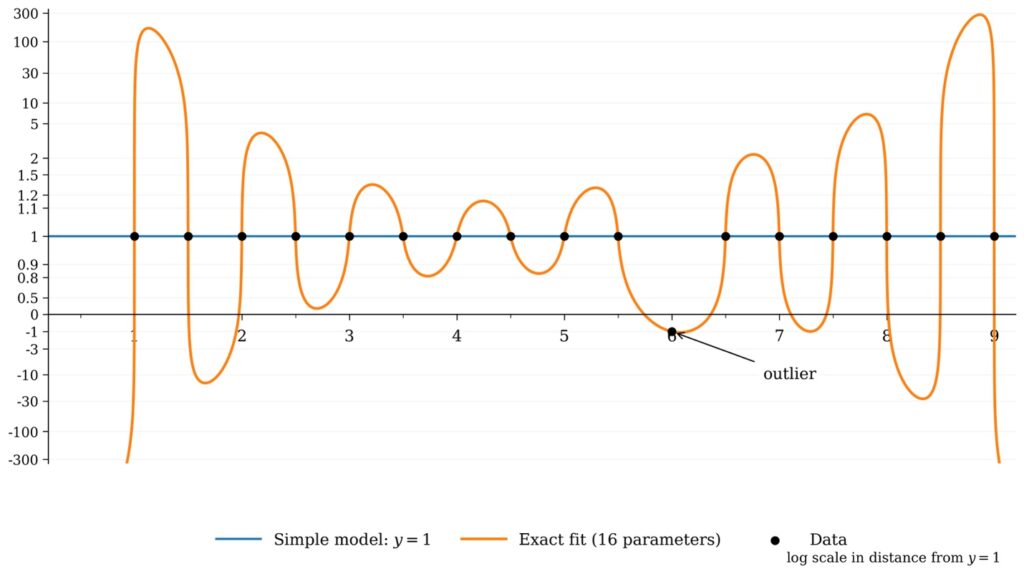
Which line do you think better captures the data?
If you are not quite sure, we may take the example a step further. Suppose that the scientists who collected the data graphed above make a new measurement, quite compatible with their previous ones: (.5, 1). The simple model y = 1 of course fits this new data point perfectly; it need not be revised to accommodate it. By contrast, the polynomial of exact fit predicts that when x =.5, y = -24,751! That is a wild predictive error. To accommodate the new data point, the latter model clearly must be revised. In checking whether a model has been ‘overfitted’, how well (or poorly) it fits new observations is one of the main things that scientists look for. In effect, as with the polynomial of exact fit above, overfitted models buy fit with the existing data at the cost of fit with new data.
Inspecting the model that results from revising the polynomial of exact fit above so as to fit the new measurement provides yet further evidence of a problem.
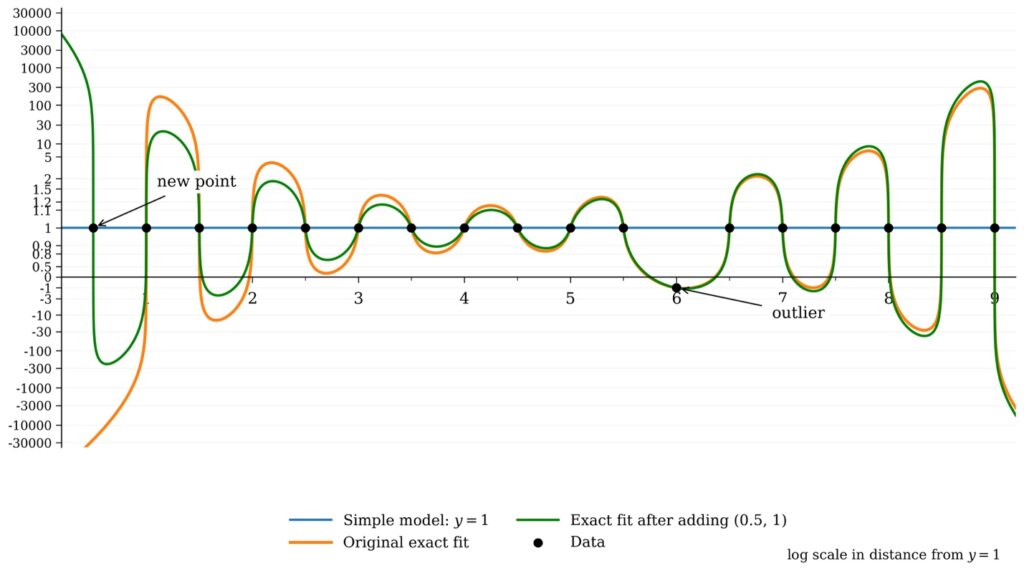
Notice how differently the new polynomial of exact fit behaves from the previous one as x approaches 0: even though only a single new – and hardly very surprising – data point has come in, suddenly some of the predictions are radically different. That pattern of senseless oscillation is typical of attempts to keep overfitted models up to date. It reinforces the conclusion already suggested by a sane inspection of the original data: namely, that there is something weird about the outlying data point (6, -1), and something wrong with models that treat it just on a par with all the others.
Polynomials of exact fit are an especially simple and vivid example of overfitting. Taking a step back from them, the widely accepted methodological point is that overfitting makes for a vicious dynamic in which complication after complication is added to an already unwieldy model as it struggles to accommodate new evidence. Such a fate befell attempts to save the geocentric model of the solar system in the midst of the Copernican revolution. More generally, attempts to develop scientific theories which fail to control for the danger of overfitting tend to develop into what the philosopher Imre Lakatos called ‘degenerating research programs’: their metastasizing layers of theoretical complication are symptoms of incurable intellectual ill-health.
If simplicity is such an important constraint on scientific theorizing, why isn’t that fact better known? One reason for simplicity’s lack of recognition is that it is so primitive a constraint as to do much of its work behind the scenes, before consciousness gets a look in. Again, think back to school science classes. Probably, it never even occurred to you to use polynomials as complex as the ones in the graphs above to model the data which you were given. In effect, considerations of simplicity sharply delimit one’s sense of what theories or models are worth taking seriously in the first place. The role of simplicity in reducing the number of theories that scientists have to make a reflective choice between is part of what makes such a choice feasible at all.
Though it can be tempting to draw a hard-and-fast distinction between scientific and non-scientific thought, the danger of overfitting is general. It is not specific to science. Their long experience with the exigent difficulties of making sense of large and messy data sets has forced modern researchers to worry explicitly about overfitting, at least when doing science. We submit that there is a much broader lesson to be learnt, one with ramifications far outside of quantitative sciences. All human thinking is vulnerable to the kind of threat that scientists have recognized. Lots of our knowledge comes in the form of generalizations or what could, in at least a loose sense, be called ‘theories’ which we try to bring into some relationship of fit with the ‘data’ or ‘evidence’ that we collect from the world. Overfitting is therefore potentially endemic to human thought.
Ascendant exceptionalist forces have presided over a reign of terrifying stupidity.
The connection we have in mind between exceptionalism and overfitting is this. Overfitting is a key symptom of exceptionalism. Exceptionalists are people who are disposed to make too many exceptions; the concomitant attempt to build those exceptions into their theories and models manifests the methodological vice of overfitting. Exceptionalism names a pathology of mind, overfitting a pathology of methodology. But don’t be in any doubt that the two are closely related. It is useful to have both terms on the table because ‘overfitting’ allows us to talk about an independently well-understood phenomenon from quantitative science, while ‘exceptionalism’ allows us to speak, without prejudice to that science, about a pervasive vice of everyday cognition.
Some readers will treat with contempt the idea that exceptionalism, if it is supposed to be a pervasive vice of everyday cognition, has anything much to do with overfitting. It may strike them as audaciously scientistic to generalize a scientific pathology to ordinary thought and talk. In the background to their reaction may be some version of the thought that science alone is a domain of robust and discoverable truths, and everything else somehow intractable or subjective.
For now, we will limit ourselves to just one point in response. Science may be distinguished by its rigor and systematicity. But it has no proprietary claim on generalization. The ability to generalize successfully is a basic feature of intelligent minds. Babies do it innately, as likely do non-human animals. The ability to generalize proficiently is bound up with the mind’s primitive powers of abstraction and categorization. In humans, there is evidence that the capacity to generalize precedes the acquisition of language. Infants as young as a few months are able to generalize properties among perceptually similar objects. Once language is acquired, an individual’s capacity for more abstract forms of generalization is greatly enhanced. But even if all generalization were somehow linguistically mediated, it would be a serious error to think of it as under conscious or reflective control. Much of what deserves to be called generalization takes place at a level of cognition inaccessible to conscious awareness.
Given the centrality of generalization to human cognitive life, it is to be expected that threats to knowledge of general truths are common, too. The most obvious such threat is from spurious counterexamples. When a counterexample to a simple generalization is spurious, attempts to accommodate by the exceptionalist tactics of complicating and restricting the generalization looklike overfitting (compare complicating and restricting the generalization “the value of y = 1 for every value of x” to accommodate the outlying data point). Those whose first reaction is to think that indulging such complications is rarely overfitting – as opposed to just fitting – should pause to notice the consequence of such a doubt, if accurate: that a basic cognitive capacity is fundamentally unreliable. Would we expect that same doubt to be taken at all seriously if voiced as a reason to abandon scientific methodological self-discipline?
Skeptics about whether overfitting can happen outside of science risk implicating themselves in an ill-conceived global skepticism about knowledge quite generally. If you do meet someone who dismissively tells you we don’t or shouldn’t rely on simple generalizations in our own conscious thought, feel free to point out to him that the view that we don’t or shouldn’t rely on simple generalizations is itself a simple generalization of exactly the kind being rejected. Indeed, when the practice of generalization is considered in appropriate generality, it becomes radically unclear what the proposal that we cease thinking in terms of generalizations amounts to.
One might sum up the situation like this. Exceptionalists will balk at the extrapolation of widely accepted methodological standards to human thought across the board. They will think of everyday cognition as an exception to the rule. But then they would, wouldn’t they?
If we are right, and the threat of overfitting pervades all of human thought and action rather than merely a small part of it, then our theory predicts that we should find the symptoms of overfitting and the exceptionalist syndrome that gives rise to them everywhere. That prediction is amply confirmed. For a brisk diagnostic tour, we turn to politics, society, ethics and the art. Those domains are often conceived of as radically internally disunified. But they are also rife with generalizations: such as that suppressing knowledge is bad, technological progress enabled by capital markets is good, that beauty is better than ugliness, intelligence better than stupidity, criminality undesirable, and scientific and artistic advancement valuable ends in themselves. In virtue of being generalizations, these are vulnerable to the same methodological worries that scientists have worried about when handling data. That is: we need to be careful about not over-reacting when we appear to get evidence that counts against them.
That care has not been taken. Instead, ascendant exceptionalist forces have presided over a reign of terrifying stupidity.
Exceptionalism in the wild
‘Can a woman have a penis?’ Remarkably, this inquiry continues to be regarded as a gotcha question in some mainstream political circles. Among the wider public it is correctly employed as a valuable heuristic test of a public figure’s capacity for honesty or a minimal claim on intelligence.
The central questions raised by transgender theory – namely, whether women are adult human females and men adult human males – may not be the most perennial of political problems. But their clear-cut character makes them an invaluable exemplar of overfitting at work.
The hypothesis that women are adult human females, and men adult human males, succeeds by the general methodological standards of good theory construction. That is, words like ‘human’, ‘adult’ and ‘female’ are independently well-understood and perspicuous. Consistency with well-established theory in other areas is a generally recognized virtue, and terms like ‘human’, ‘adult’ and ‘female’ are central theoretical terms in evolutionary biology, a successful branch of modern science. Along with its simplicity and fit with the evidence, these considerations establish the sex-based view of womanhood as the default view in the theoretical vicinity. Those who think it false – let alone so obviously false as to make its expression morally wicked – face the burden of proof in explaining why.
So far from discharging that burden, many modern accounts of the nature of gender and sex allow complication to run rampant without a hint of methodological self-awareness. If anything, over-complication often seems to be regarded as something of a goal by these theorists. The political goal of inclusivity dovetails with the methodological aim of fitting the curve to every data point. Modern theorists of gender think of themselves as theoretical pioneers; unfortunately, as is well known, pioneers can sometimes attempt to settle land to which others have a better claim. Though their models of gender seem agreeably nuanced and inclusive to them, by standards of good model-building they are paradigms of bad science.
The habit of exceptionalism is pervasive and entrenched. Once you develop an ability to pattern-match for it, you will start seeing it more or less everywhere in today’s world. That is not to suggest that exceptionalism is a peculiarly modern vice – the kind of ‘presentism’ that consists in thinking that the modern world is exceptional (usually, that it is exceptionally dysfunctional) is itself a manifestation of the very pathology we are describing. Presentism is exceptionalism about one’s location in time.
One reliable symptom of an exceptionalist’s influence comes when a simple, attractive goal or project is burdened down with ad hoc complication. Take universities. A simple, attractive construal of their reason d’être is the generation and promulgation of knowledge. Accordingly, the students they select for should be those most capable of acquiring knowledge: that is, in other words, of learning. In recent years, however, the most elite universities in the Western world have abandoned standardized tests and other reliable metrics of intellectual ability. Often, the central goal of knowledge dissemination is explicitly qualified by other desiderata, like the correction of social injustice or the creation of a ‘diverse academic community’. Added as parameters to the aim of education, such constraints risk overfitting.
On campus, simple norms, such as that speech should be free and academics unconstrained to pursue lines of research, have been repeatedly transgressed. Many student activists take for granted that whatever value free speech has must be of a highly qualified kind: perhaps it is only valuable so long as it doesn’t offend vulnerable members of the community, helps to ‘platform’ fashionable political views, is exercised with one’s privilege in check, and serves any other arbitrary number of disconnected political goals. Such activists have thoroughly got the hang of the overfitting urge.
Needless to say, there are many false, but simple, generalizations and rules. Yet, somewhat ironically, the exceptionalist’s knack for making unprincipled exceptions often leaves him puzzled in the face of real exceptions to merely apparent rules. (He is not even master of his own specialism). To take up another politically-charged example: it is not true that everyone is by nature equally likely to commit a crime. Most crimes are committed by a relatively small number of repeat offenders. Recidivism rates cross-nationally and cross-culturally are very high, to the point that permanently imprisoning repeat offenders would eliminate the majority of crime. This is exactly what is to be expected on the assumption that the traits relevant to criminal behavior are normally distributed among the population. Instead of noticing the simple pattern in the data, exceptionalists usually invoke all manner of complex social and political mechanisms to explain the observed phenomena. Their theories lead them to extraordinary practical conclusions: notably, the left’s call for ‘police abolition’ accompanied by the expressed conviction that this will quell crime.
Many exceptionalists are by instinct blank-slatists. In conversation, they do an uncanny job of seeming to believe that everyone is born the same, and that all psychological or intellectual differences that emerge as children mature into adults are the result of cultural learning and social reinforcement. This isn’t all that surprising: shunning the simple, general explanations that are often provided by appeal to innate traits frees the exceptionalist up in a range of specific cases to make all kinds of ad hoc moves to explain behavioral, psychological and social phenomena. (“Crime is caused by a complex array of social factors”; “there is no such thing as innate sex”; “nobody is naturally more intelligent than anyone else”).
As it often does when pathological examples are wanted, trans ideology stands out, being both nauseatingly complex and crazy on its face.
Blank-slatism exemplifies exceptionalism about both humanity and mind. After all, even blank-slatists typically recognize that intellectual and psychological differences in non-human animals are frequently the result of evolution, as too are physiological differences between humans. In effect, blank-slatism is an artificially restricted hypothesis of just the kind that considerations of overfitting warn us to treat as suspect. Another telltale sign is that blank-slatists often enact great complication when applying their theory: complication that could be avoided were it simply assumed that people vary at the population level with regard to many natural traits. As with the nursery rhyme about the old lady who swallowed a fly and then found herself swallowing all kinds of other farmyard animals to deal with the consequences, the effort to correct for the widening ramifications of exceptionalist error can quickly get out of hand.
One exceptionalist of recent vintage not scared to let things get a little out of hand was the lockdown fanatic. Eyes firmly on a single objective – namely, the minimization of deaths from a specific strain of coronavirus – he was breath-takingly successful in leveraging it to shut down all other concerns. As will be easy to remember for those who have yet to ‘memory hole’ this bizarre period of recent history, covid exceptionalism had vividly dysfunctional consequences. At the individual level, reports suggested that many people stopped presenting at hospital with symptoms of far more critical conditions, including strokes and heart attacks. The elderly were subject to often prolonged, unwanted isolation and suffering at the hands of the government at the end of their lives – all in the hope that it would prevent prolonged and unwanted suffering at the hands of an illness at the end of their lives. Children and young adults had their education and social and romantic lives disrupted for years, despite being at virtually no risk of death from the disease – a statistical fact that, being so potentially subversive of teaching unions’ conviction that they were morally obligated to enjoy years of paid leave for the sake of their students’ health was for the most part safely kept off the air. Western governments added trillions of dollars collectively to public debt. Measured purely in terms of its opportunity cost, such spending represents a massive diversion of resources away from worthwhile causes towards a pointless one. Lockdown was an exceptionalist overreaction.
One way to simulate the thinking of lockdown enthusiasts is as assigning absolute weight to a function minimizing deaths from covid, and simply ignoring every other desideratum, including those that were also tightly bound up with collective wellbeing. In modelling, scientists are often worried about a tendency to overfit an entire data set; but another way to be irresponsible with data is to irrationally prioritize fit with just a few special points. That is also a manifestation of exceptionalism: exceptionalism about those points – what we earlier called ‘single-minded exceptionalism’. Ultimately, the discovery that ‘overfitting’ may be less than fully apt for describing non-scientific practice is not a sign that folk cognition is less vulnerable to the danger of reading too much into bad data, but an indication that it is more vulnerable to the danger of neglecting good data: as it were, of over-complicating and under-fitting at one and the same time. As it often does when pathological examples are wanted, trans ideology stands out, being both nauseatingly complex and crazy on its face.
By now, other examples of exceptionalist errors will no doubt be occurring to you. Environmental policies, including the dogged pursuit of net zero emissions targets by many Western countries, exemplify the very same single-minded exceptionalism as did the panicked response to Covid-19. Planning restrictions, especially the NIMBYist character of house-building regulation, in which many small considerations of marginal social importance are allowed to trigger vetoes on development projects, too, involve rabid overfitting with catastrophic effects. In the world of art and culture, the simple goal of producing entertaining work is routinely qualified and subordinated in all kinds of ways, so as to serve dubious goals of social justice, and in such a way as has robbed much artistic work of its intrinsic interest. Examples could continue to be multiplied.
Even those with some sympathy for our specific diagnoses may worry that a global theory of such general applicability must conceal some defect. Is our theory of exceptionalism somehow trivial? We don’t think so. Not all errors are exceptionalist errors, after all. The framework may apply more cleanly to some cases than it does to others. In the round, it reveals a striking uniformity to some of the problems in our political culture. More seriously, might it be that the exceptionalist diagnosis, especially of ‘single minded’ exceptionalism, is somehow self-implicating? Are we attaching too much importance to a single explanatory idea? The best strategy may be to let the fruitfulness of the idea speak for itself.
One striking attraction of anti-exceptionalism is that it provides the basis for a political critique that does not ultimately draw on distinctively political assumptions. Many social and cultural errors are first and foremost intellectual errors and can be exposed on those terms. The failure of nerve that makes exception-making a temptation has far-reaching consequences. It is a vice that parades as virtue. It stands in the way of human progress and achievement. It lends unwitting defense to the indefensible. Its destructive effects may not always be immediately obvious, but they are no less real for that. Over-complication, in thought and action, is regressive.
Daniel Kodsi is editor-in-chief of The Philosophers’ Magazine and a Visiting Scholar in philosophy at NYU. John Maier is a doctoral student in philosophy at Balliol College, Oxford, and an Emerging Scholar at the Mercatus Center.