25 March, 2026
Restaurants, hotels, fashion labels, and real estate agents love to describe their offerings as “exclusive”.
But isn’t that odd? “Exclusive” quite literally means we exclude people, which is to say: we discriminate. Not excluding others is one of the first and most important lessons we try to teach our children in kindergarten and on the playground, and “you can’t sit with us” is all it takes to characterize the clique around Regina George in the film Mean Girls as exactly that: unlikeable, snobbish, and cruel. And yet: the fact that something is exclusive – that not everyone can afford it, that it is reserved for the few, that it is a privilege – is enough to make it seem desirable to us.
That we live in a society with considerable social and material inequalities is obvious, as are politicians’ campaign promises to tackle and finally eliminate them. But I bring bad news: we live in a class society, a society that enables and celebrates exclusivity, and this will remain the case, because the social and institutional mechanisms that produce social status segregation cannot be effectively neutralized under modern conditions in complex, large-scale societies like ours.
Socially constructed scarcity
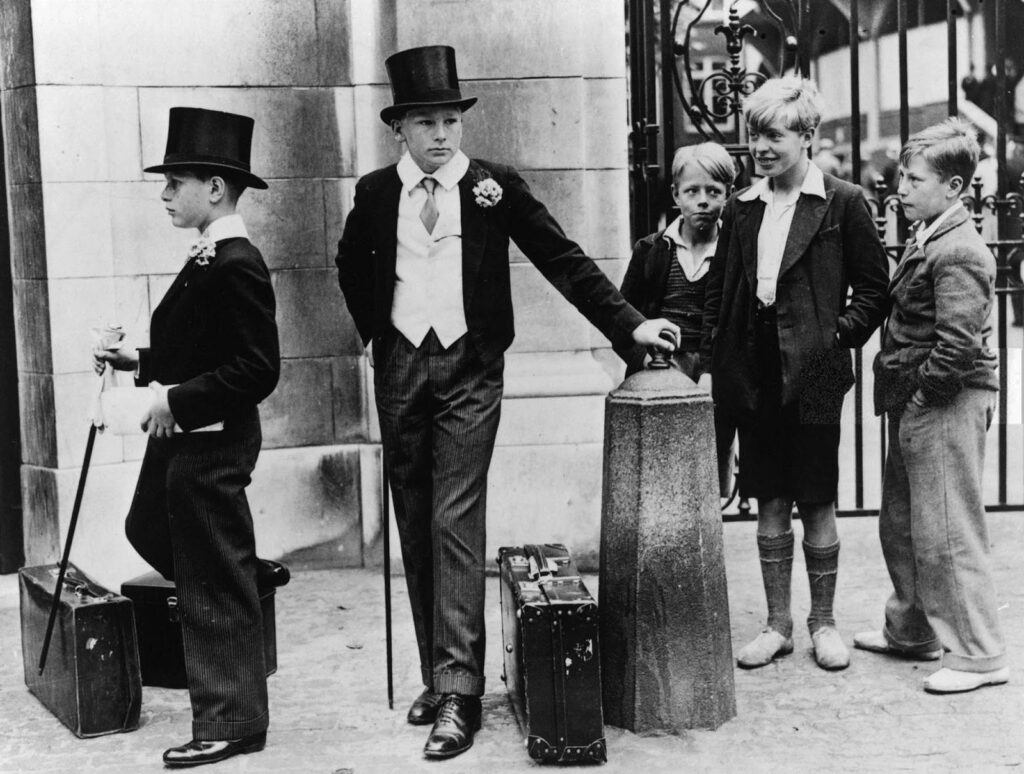
What is class? My preferred understanding of what class hierarchy consists in is that it is a kind of socially constructed scarcity. This scarcity arises through status competition between individuals and groups, fought out with “hard-to-fake” social signals. Over time, such status competition gives rise to stable social strata that differ noticeably from one another in their material resources, cultural preferences, everyday habits, aesthetic sensibilities, power, and influence. These groups then start to form a social hierarchy. A top and a bottom emerge.
We must learn to live with such class differences. This is unpleasant and unjust, but nobody ever promised us that we could effectively fight, much less eliminate, every injustice. Some problems cannot be solved.
This understanding of class as socially constructed scarcity is decidedly non-Marxist. Marx believed that the end of economic scarcity would spell the end of class society. After all, why do classes exist in the first place? Classes arise, according to Marx, out of a struggle between social groups over a scarce economic surplus; some social groups then manage to appropriate a disproportionate share of that surplus. The moment the forces of production unleashed by capitalism usher in the end of economic scarcity through overwhelming material abundance, class society disappears too – because the very rationale for any sort of class struggle has withered away, and now there is enough of everything for everyone.
But Marx underestimated a crucial fact, articulated with final clarity only by the American economist Thorstein Veblen in his magnificent 1899 book The Theory of the Leisure Class: that scarcity always remains relative, because the standards of what counts as “enough” shift dynamically. Material scarcity can, in principle, be eliminated; socially constructed scarcity cannot.
The upper classes distinguish themselves through the conspicuous consumption of leisure and waste, distancing themselves as far as possible from the “lower” classes. Pierre Bourdieu later called this social distinction, manifested in people’s lifestyle, cultural preferences and habitus; and current theories of costly signalling describe how expensive status symbols – things one must be able to afford – are used to cement social inequalities.
The evolution of inequality
The fact that we possess a finely tuned perception of social prestige hierarchies has an evolutionary background: as a cultural species, we depend on acquiring almost all of our knowledge and skills from others. We are high-fidelity social learners. Social prestige is the central filter that tells us from whom it is most worthwhile to learn. Status categories such as intelligence, integrity and competence are therefore culturally universal, recognized in all societies.
New studies show that we only need seven words to identify a person’s social status from their accent, or to observe 60 seconds of their behaviour, and that we can also read a person’s socioeconomic status from their face – even when shown only the eye region, even in black and white, and even when upside down. The perception of status and class differences is so strong that it even overpowers the perception of ethnic differences: implicit class prejudice is stronger than racism, and the class salary gap is larger than the gender pay gap has ever been.
Class differences are remarkably persistent. Even the era of Chairman Mao in China could not eliminate them; descendants of pre-revolutionary elites are still substantially overrepresented at the top of China’s social hierarchy today, and someone who belonged to the wealthy Bernardis in fifteenth-century Florence is still significantly richer and better educated today than a descendant of the poor Grassos. In England, the heritability of socioeconomic status has been tracked for 400 years, and it’s near perfect.
The impotence of politics
Moreover, not even the rate of heritability has changed over time. This is truly astounding, because it means that none of the institutional reforms of the past centuries – universal literacy, social safety nets, public education, the emergence of democracy and liberalism – have made any difference to how heritable social status is. Class and status are a form of social inequality against which we seem to have almost no effective political remedy.
The conflicts and frustrations that arise from economic inequalities can in many cases be at least partially placated by economic growth, because the unequal distribution of resources hurts a little less when my personal situation improves at least slightly each year. After World War II, the issue of class inequality seemed less urgent and salient, because the socioeconomic comparison with my previous self from a few years ago always came out so favourably: all of a sudden, people had a refrigerator, then a car, then a TV, then they could travel abroad. Diachronic intrapersonal comparisons made synchronic interpersonal comparisons sting less.
But status is, as economists like to say, a positional good: unlike refrigerators and cars, we cannot produce more of it, because class differences are a zero-sum game – to make one person relatively better off, another must be made relatively worse off. Money and economic resources can be redistributed, but status is informal and symbolic and therefore cannot simply be moved from one pocket to another. In many cases, being the recipient of social redistribution mechanisms is itself status-reducing – a phenomenon known as welfare stigma.
The problem of social class differences will not only persist. It will get worse, because status anxieties increase with rising societal prosperity, since material security and post-material values intensify the relative importance of non-material, symbolic status differences even further.
The relevance of class today
Class and status are the dominant themes of our time. That might sound strange at first – isn’t class a concept from the previous century, or even the one before that? Aren’t there much more important, more urgent problems right now? The global shift to the right, or artificial intelligence, or reanimated geopolitical conflicts? But if you look closely, you notice that even here, status competition lies at the core of these problems.
The shift to the right is primarily a phenomenon of frustrated social groups that are not so much objectively worse off as their relative position in the social status hierarchy has become destabilized. The accelerated development of artificial intelligence is becoming a problem because the creative and intellectual classes in cities will very, very soon become tangibly under threat – AI will be a better graphic designer, actuary, programmer, and screenwriter than most humans, meaning that for the first time it is the knowledge workers whose class position is seriously imperilled. The current Vice President of the United States became famous with a book that was explicitly about how a man from poor, working-class Ohio – shaped by domestic violence and alcoholism – made his way to Yale and then to Washington to fight against the detached and corrupt elites and to make politics for the little man (which is to say, enact tax cuts for the wealthy and start pointless and destructive wars). And one should not underestimate the role status competition plays in international politics: some autocrats reason that if their country can’t be the most innovative, or the wealthiest, or the healthiest, or the best educated, then at least it can be the largest. Almost all of the problems that will occupy us in the coming years and decades – climate change, immigration, birth rates – involve social status competition and class hierarchies, and what they mean for us.
Getting rid of class hierarchy is unrealistic. But why should we scrutinize political concepts and social ideals as to whether they are actually achievable? Why be held back by ugly facts? Why not reach for the stars?
The reason is that the attempt to chase hopeless ideals has political consequences: it destabilizes long-term trust in the legitimacy of a political system when its representatives endlessly proclaim goals that are never accomplished because they cannot be. Eventually, those being governed begin to suspect that something is off– that they are being taken for fools, that darker forces are at work. Are we being lied to? Do those at the top not actually want those goals? Or do they want them, but are being manipulated by even more powerful, yet invisible, grey eminences pulling the strings in the shadows? This is the fertile ground on which conspiracy theories and political paranoia flourish, with all their historically all-too-familiar consequences. I am not advocating for an unimaginatively cynical ultra-realpolitik that does not posit any desired outcomes beyond what is feasible and succumbs to treating the factual as normative – only for the warning that frustrated ideals can be politically dangerous. A certain minimum regard for what is socially, politically, and institutionally achievable is a valuable corrective.
Classism
We live in a class society, and we may lament this fact. Social inequalities exist and are passed down from generation to generation. They are defended, downplayed, disguised. This is unpleasant and unjust, but there is little we can do about it, because the mechanisms that produce social status hierarchies are difficult or impossible to disable in modern, complex, large-scale societies like ours. We will therefore have to learn to live with those class differences.
What we don’t have to do, however, is make things worse — to pile on, to sprinkle even more classist salt into the wounds of injustice. Because it is one thing to have to suffer from social disadvantages, and quite another to suffer from social disadvantages that are widely accepted and treated as legitimate. But classist discrimination is exactly such a case: it not only produces unjust socioeconomic conditions, but also legitimizes them through the way we speak, think, and act.
In mainstream media, classism is everywhere. In blockbusters like The Lord of the Rings, “the good guys” — the noble elves and the quaint hobbits — speak with the accent of the English upper and upper middle classes: the aristocracy and the comfortably situated London professional world of doctors, lawyers, bankers, and cultural figures. The “evil” Orcs, by contrast, speak with the working-class inflection of London’s East End or – horribile dictu – northern England. They are, in effect, the underclass of Middle Earth, portrayed as brutal, subhuman, and depraved. In countless comedies, poor people are depicted as lazy idiots or unhygienic lowlifes, and in films like Pretty Woman or The Princess Diaries, the socially left-behind heroines must first be rescued from their fate by wealthy and/or prestigious benefactors before they can prove themselves worthy of love. A similar storyline in which a young black woman only earns a better life by conforming to the conventions of white mainstream society would, by contrast, be unthinkable. And many films are set in places like Manhattan, Beverly Hills, or Notting Hill, whose functioning depends crucially on the contributions of a working and service class of cleaners, janitors, shop assistants, and garbage collectors — who are almost never shown, and when they are, only as extras or background figures with no identity, personality, or story of their own.
Why is this? Why aren’t classist prejudices challenged far more forcefully? One important factor is that classist segregation – the separation of social status groups across neighbourhoods, schools, and universities – is so deeply embedded in our society. You literally cannot leave the house without moving through socially class-structured spaces.
Our language, too, is permeated by these structures. Derogatory terms for ethnic or sexual minorities do exist, but their use is heavily socially sanctioned and has largely disappeared from the public sphere. “Rough neighbourhood” or “chavvy”, by contrast, is a vocabulary used liberally and without shame by almost everyone. “Low earner” (Geringverdiener) was one of the “youth words of the year” in Germany in 2021 – and everyone found it hilarious! Except perhaps the actual low earners, I suspect – people who not only have to ride the cold bus to poorly paid, gruelling work every morning, but also have to endure being mocked and indeed blamed for it. Over the past ten years, we have talked about a lot about how we can improve our language to be more inclusive towards the vulnerable and less discriminatory against minorities. How often did I see someone suggest that, in addition to removing racist and sexist words from our idiom, we should also stop saying things are trashy, or posh, or vulgar? Not once.
There are no easy solutions here either, because the fact that we categorize people according to status and prestige is, in principle, often reasonable and contains important information. When seriously ill, I want to be treated by the most competent specialist, who probably genuinely has the required expertise. Few people find it objectionable that the fastest sprinter wins the gold medal or that the best tennis player achieves fame and fortune as the Wimbledon champion. And many people want to attend the university where they can receive the best education. Many distinctions in prestige and status are genuinely legitimate and unproblematic – which is precisely why the illegitimate and problematic ones so often go unnoticed. That is why it is worth sharpening one’s awareness of one’s own classist prejudices and examining them more critically. Because if you are reading this article, you too are a good candidate for being one of those who benefit from social status hierarchies and privileges.
Classless society
“Your mother has so little class she could be a Marxist utopia” is one of the better examples from the otherwise not particularly sophisticated genre of “your mother” jokes. (Isn’t “sophisticated” a classist term as well?) The dream of a truly classless society is dreamed everywhere in the world, but lived nowhere. We cannot rid ourselves of the mechanisms that produce it.
Imagine you lived in a society where nobody trusts you, nobody wants anything to do with you, nobody wants to be your friend, nobody wants to talk to you, invite you to a celebration, do business with you, love you, or care for you. Now imagine you could acquire an object – an amulet perhaps, or an app, or a particular kind of hat, or an artifact endowed with magical powers – through whose powers you could enchant other people to suddenly want to do all of these things with and for you. Suddenly, out of nowhere, everyone wants your advice, wants to spend time with you, go out to eat with you, lend you money, have sex with you and hire you. Would you want that object? Of course you would. You would want it, and so would I. The punchline: such an object exists. It is social status. It is the most coveted resource of the modern world.
Hanno Sauer is Associate Professor of Philosophy at Utrecht University, the Netherlands. His most recent book, in German, is on class: Klasse: Die Entstehung von Oben und Unten (2025). Before that, he published The Invention of Good and Evil: A World History of Morality, which became an international bestseller and was selected as one of the best books of 2024 by The New Yorker, The Economist, and others.